1. What Is a Sagging Buttock Lift?
A sagging buttock lift, also known as a gluteal lift, lower body lift, or lower back lift, is a surgical procedure designed to remove excess skin and tissue from the upper buttock area while lifting and repositioning the gluteal tissues to a higher, more youthful position. The result is firmer buttocks, improved contour, and smoother, rejuvenated skin.
2. What Does an Ideal Buttock Look Like?
An aesthetically pleasing buttock is not defined by size alone, but by its proportion and harmony with surrounding body areas.
Ideal buttocks have some key characteristics, such as:
- Full, rounded shape
- Firm, smooth skin
- A well-defined but natural gluteal fold
- Symmetrical and balanced proportions
Adequate projection is essential. Lack of projection may be caused by genetic volume deficiency or skin laxity due to aging or significant weight loss.
The adjacent regions also hold key roles which strongly influence the appearance of the buttocks. Excess fat in the flanks (love handles), lower back, or upper thighs can obscure important features like the Venus dimples or the gluteal fold definition.
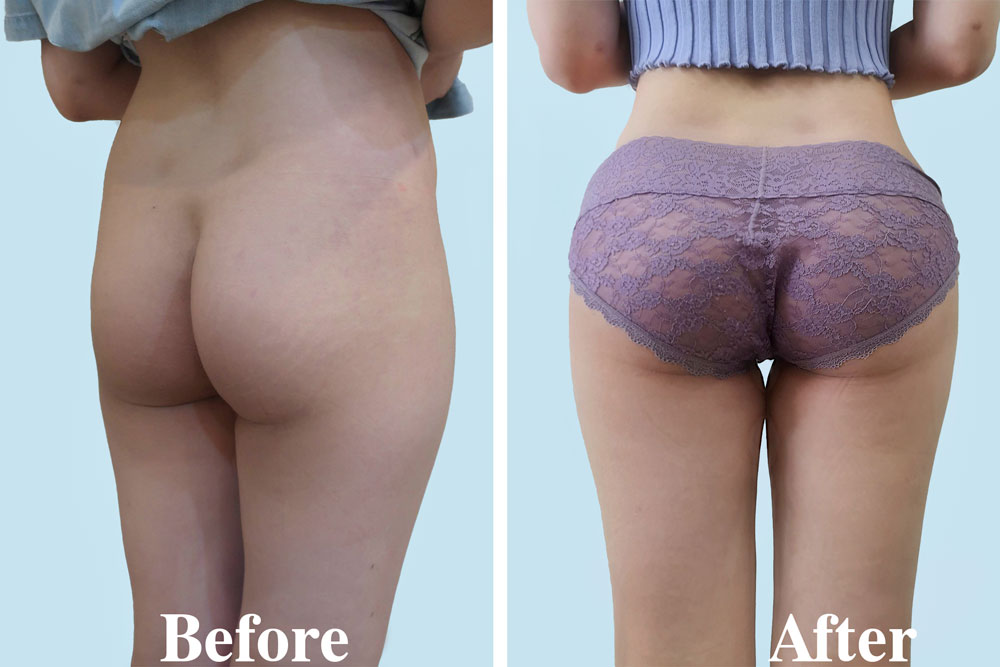
Client's buttocks showing ideal Venus dimples and infragluteal fold after undergoing buttock lift
3. Treatment Options for an Attractive Buttock Contour
The optimal approach depends on each patient’s anatomy and aesthetic goals.
|
Condition
|
Treatment
|
|
Poor contour due to excess surrounding fat
|
Liposuction with skin tightening of the related regions:
- Restore Venus dimples: Liposuction of lower back/flanks.
- Define gluteal fold: Liposuction of upper thighs
|
|
Volume deficiency (flat buttocks)
|
Apply augmentation techniques including silicone implants, dermal fillers, or autologous fat grafting
|
|
Adequate Volume but Sagging due to aging
|
A Buttock Lift (Gluteal Lift) helps lift and tighten sagging skin and tissues to a more youthful position
|
|
Complex Cases
|
A combination of the solutions above
|
4. The Procedure of Sagging Buttock Lift
Step 1: Treatment planing
The surgeon evaluates the degree of sagging and designs a personalized surgical plan, including incision placement and any adjunct procedures if needed to achieve optimal results.
Principles of incision design:
- Remove sufficient excess skin and fat without creating excessive tension
- Place incisions in locations where scars can be well concealed after recovery.
Incision locations:
- Bikini-line incision: Extends along the lower back or hip area and is easily concealed under swimwear. Suitable for removing excess skin and fat from the lower back.

- Gluteal fold incision: Located along the natural crease beneath the buttocks, making it completely invisible after healing. This technique primarily improves skin tightening rather than projection. Therefore, it’s only suitable for patients with adequate projection.

Step 2: Surgical preparation
General anesthesia or sedation is administered to ensure a comfortable and pain-free experience during the entire procedure.
Step 3: Removal of excess skin and fat
Precise incisions are made based on preoperative markings to remove excess skin and adipose tissue.
Step 4: Lifting and fixation of gluteal structures
Gluteal tissues are elevated and repositioned, and then secured with sutures to maintain long-term contour. Drainage tubes may be placed to prevent fluid accumulation and support proper healing.
5. Recovery and Post-Operative Care
Recovery timeline:
- 2-4 weeks: Compression garments are typically worn to reduce swelling and support tissue stabilization
- After 10-14 days: Sutures are usually removed
- First 2–3 days: Drainage tubes (if used) are generally removed
Important Note:
- Strictly adhere to post-operative care instructions
- Maintain proper wound hygiene
- Take all prescribed medications as directed
- Attend all scheduled follow-up appointments
Related topic:
+ Endoscopic buttock augmentation
* The result achieved also depends on each individual's physiology.