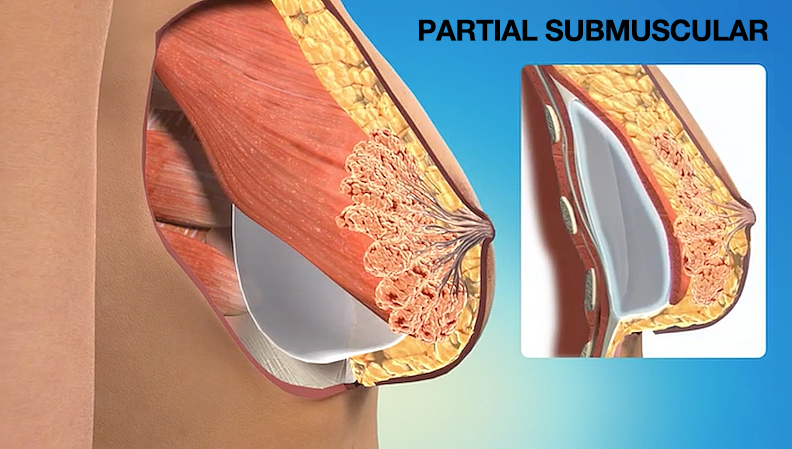
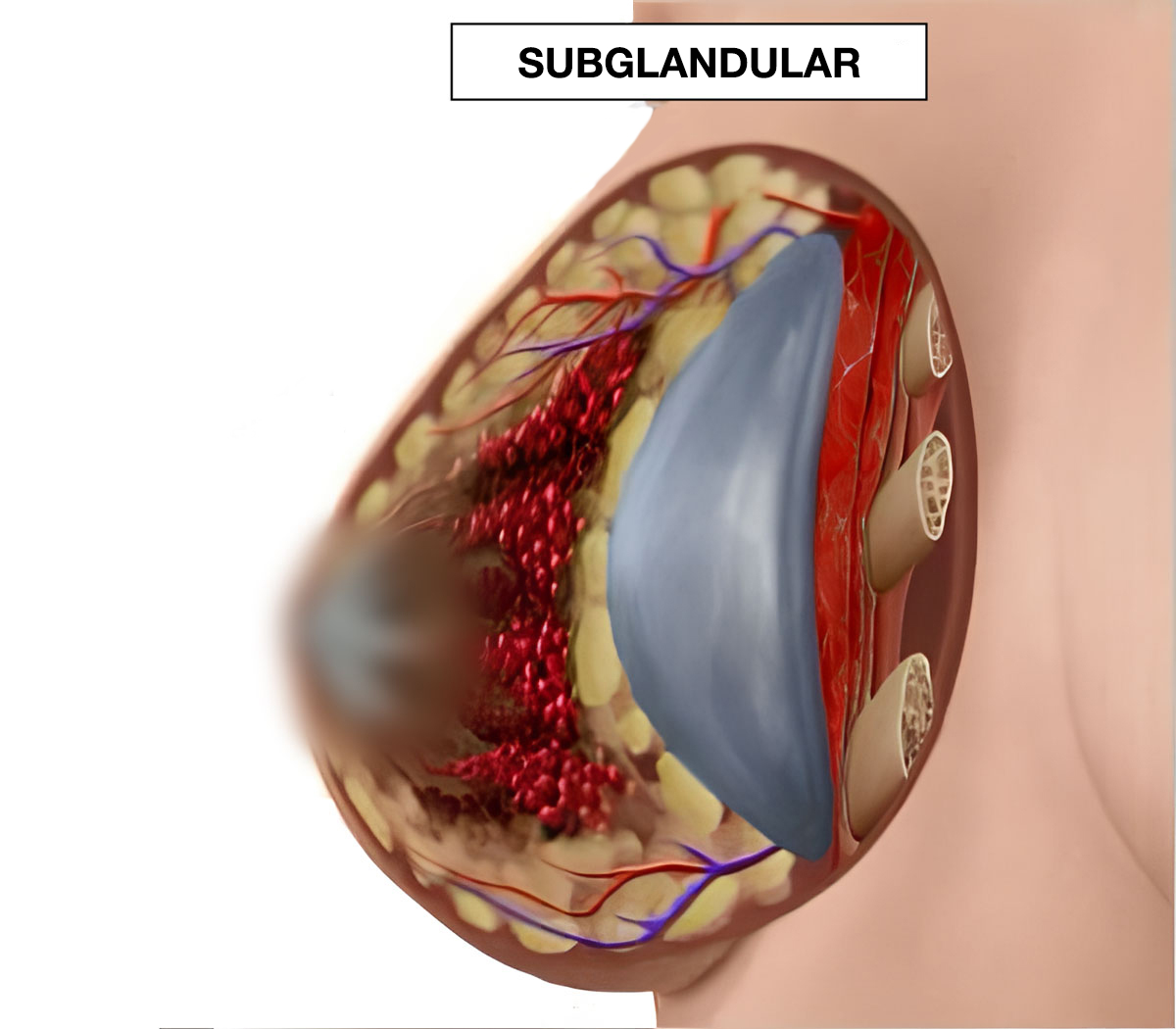
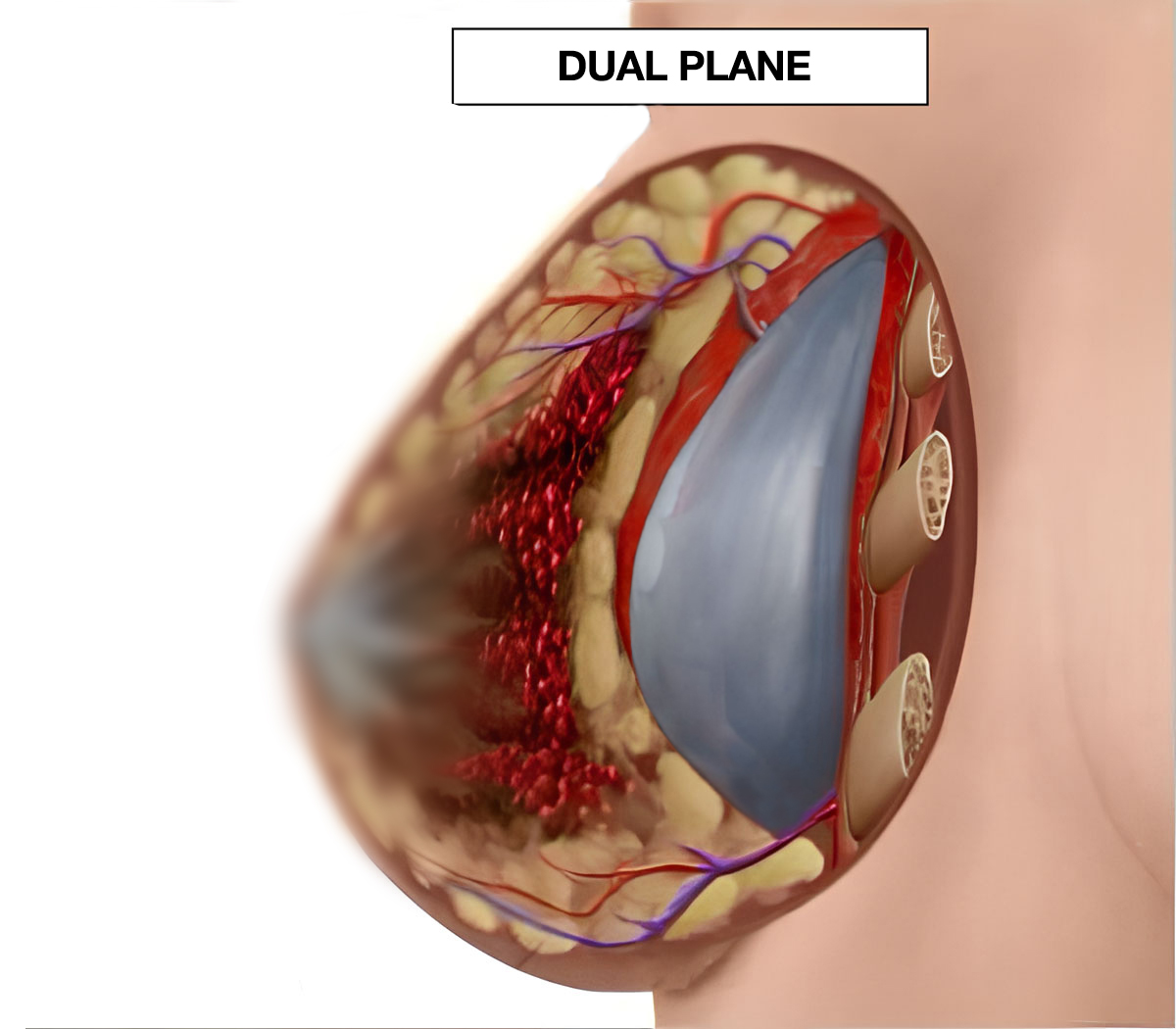
Dual Plane breast augmentation is an advanced variation of the submuscular implant placement technique, widely used in modern breast augmentation surgery. Traditionally, implants are placed in one of two positions: subglandular (above the chest muscle) and submuscular (beneath the chest muscle).
With the Dual Plane technique, the implant is positioned in two anatomical layers: the upper and middle portion is placed beneath the chest muscle, and The lower portion is positioned beneath the breast gland. The extent of muscle coverage depends on each patient’s breast anatomy, skin laxity, and degree of sagging (ptosis). Therefore, selecting an experienced plastic surgeon is crucial to achieving optimal results.
How Does Dual Plane Differ from Traditional Breast Augmentation?
Subglandular implant placement
Submuscular implant placement
Dual plane implant placement
The Dual Plane method follows similar steps to conventional breast augmentation, including the creation of an implant pocket. During this step, the surgeon lifts and separates the chest muscle from the chest wall to create space for the implant. However, in the Dual Plan technique, the surgeon performs an additional step by partially releasing the breast tissue from the upper portion of the muscle covering the implant. This creates a pocket that is supported by the 2 separate plans: under the muscle and under the gland.
The purpose of this additional step is to facilitate better shaping. Because the chest muscle is relaxed and becomes more flexible, the final breast shape appears more natural compared to implants placed entirely under the muscle or entirely under the gland. The surgeon will then adjust the implant pocket and positioning to achieve the most aesthetically pleasing result before closing the incision.
Advantages of Dual Plane Breast Augmentation Compared to Subglandular and Submuscular Technique.
If you are experiencing true breast sagging (ptosis), the short answer is no.
The Dual Plane technique can be adjusted to enhance fullness in the lower breast for women with mild sagging or pseudo-ptosis (when the nipple is not positioned below the inframammary fold), creating the appearance of sagging breasts. However, for patients with true ptosis, the Dual Plane technique cannot replace a breast lift. Although a strategically placed implant can improve breast projection and elevate the nipple-areola complex, combining breast augmentation with a breast lift provides the best long-term results.
Types of Dual Plane Breast Augmentation
Comparison between dual-plane breast augmentation and other techniques
There are three types of Dual Plane techniques. Type I is the standard approach. Type II is used for mild sagging, and Type III is applied in cases of more significant sagging, close to true ptosis.
Technical details of Dual Plane Type 1
In Type I, the lower portion of the pectoralis muscle is detached from the chest wall to create the implant pocket. The muscle remains attached to the breast tissue above and is not elevated too high. With this approach, only the lower portion of the implant lies outside the muscle coverage. Since the upper part of the muscle stays attached, contracting the chest muscles may pull on the implant and cause a noticeable indentation along the breast shape. This is a common occurrence called animation deformity, which appears only when the muscle is engaged.
Technical details of Dual Plane Type 2 and 3
Compared with Type I, this technique involves partially releasing the breast tissue from the pectoralis muscle to about the level of the nipple, depending on the extent of breast sagging. A pocket is then created beneath the muscle, after which the lower border of the muscle is detached and adjusted into the proper position. The implant is placed, and the incision is closed. With this approach, only the lower half of the implant is covered by breast tissue, which helps create a fuller lower breast contour.
Risks of Dual Plane Breast Augmentation
The risks and potential complications of this technique are generally comparable to those of other breast augmentation methods. In Dual Plane augmentation, if the muscle is not released at the correct level, even with submuscular placement, the implant may sit too high and the likelihood of breast sagging can increase. However, these risks can be significantly minimized when performed by a highly experienced and skilled doctor.